Tuesday, April 24, 2012

Secrets which other men did not carry in their breasts


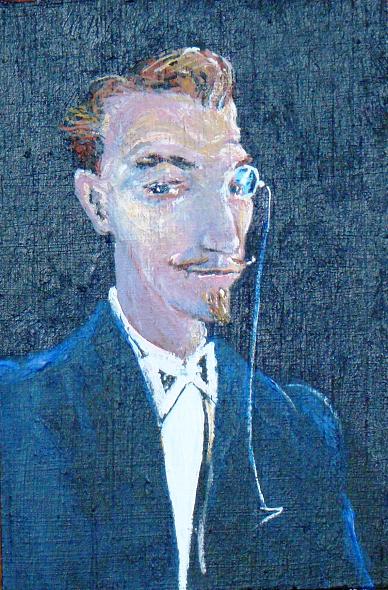
It bears repeating from my last post: we are introduced to the Baron Palaméde de Charlus, born to the Faubourg Saint-Germain, as haughty, eccentric, in his 40s, who blatantly stared at M. 

"[T]he circumspect and unceasingly restless expression of those eyes, with all the signs of exhaustion which the heavy pouches beneath them stamped upon his face, however carefully he might compose and regulate it, made one think of some incognito, some disguise assumed by a powerful man in danger, or merely by a dangerous—but tragic—individual. I should have liked to divine what was this secret which other men did not carry in their breasts and which had already made M. de Charlus stare seem to me so enigmatic when I had seen him that morning outside the Casino."


Thursday, April 19, 2012

The Baron de Charlus: an introduction

Foreshadowing the introduction of the Baron de Charlus, Proust writes, "If, when we discover the true lives of other people, the real world beneath the world of appearance, we get as many surprises as on visiting a house of plain exterior which inside is full of hidden treasures, torture-chambers or skeletons..."

The narrator first spots the Baron as a stranger who is staring at him. "He was staring at me, his eyes dilated with extreme attentiveness," and likened him to a "madman or a spy."

"He threw his shoulders back with an air of bravado, pursed his lips, twisted his moustache, and adjusted his face into an expression that was at once indifferent, harsh, and almost insulting. So much that I took him at one moment for a thief and at another or a lunatic."

When M. learns of the Baron's identity, upon meeting him later, "Swift as a lightning-flash his look shot through me, just as at the moment when I had first noticed him." The Baron 's expression had "the devout and sanctimonious look that we see on the faces of certain hypocrites, the smug look of on those of certain fools."

Thus we are introduced to the Baron de Charlus as a haughty, eccentric man in his 40's who stares at boys like M. with intensity. But there is more:

"[T]he circumspect and unceasingly restless expression of those eyes, with all the signs of exhaustion which the heavy pouches beneath them stamped upon his face, however carefully he might compose and regulate it, made one think of some incognito, some disguise assumed by a powerful man in danger, or merely by a dangerous—but tragic—individual. I should have liked to divine what was this secret which other men did not carry in their breasts and which had already made M. de Charlus stare seem to me so enigmatic when I had seen him that morning outside the Casino."

Friday, April 6, 2012

Seeing others through a spyglass

Proust spends time pondering the nature of people's shortcomings, for he says, "Each of our friends has his defects..." and adds, "...the variety of our defects is no less remarkable than the similarity of our virtues."

Proust reflects on self-awareness and appearances.

"Since the risk of giving offense arises principally from the difficulty of appreciating what does and what does not go unnoticed, we ought to at least, from prudence, never to speak of ourselves, because that is a subject on which we may be sure that other people's views are never in accordance with our own."

"Moreover it seems that our attention, always attracted by what is characteristic of ourselves, notices [defects] more than anything else in other people. One short-sighted man says of another: 'But he can scarcely open his eyes!'; a consumptive has his doubts as to the pulmonary integrity of the most robust; an unwashed man speaks only of the baths that other people do not take; an evil-smelling man insists that other people smell; a cuckold sees cuckolds everywhere. Then, too, every vice, like every profession, requires and develops a special knowledge which we are never loathe to display. And it is not only when we speak of ourselves that we imagine other people to be blind; we behave as though they were."
(emphasis mine)

Any page now, we will meet the Baron De Charlus, of the Guermantes family, and the meaning will become clear.

There is a passage I didn't quote where Proust says of homosexuality, "The inverts sniff out inverts." Proust was the first modern novelist to write openly about gays and lesbians.

Thursday, April 5, 2012

An incapacity for rancour

M. is very discreet when he learns of Odette's past, and never discusses it or holds it against her.

In the volumes to follow, M. will be singled out — and his friendship valued — for his laid back attitude.

Proust is very quietly foreshadowing what is to come when he writes:

"I did not believe what [Bloch] was saying, but I bore him no ill-will on that account, for I had inherited from my mother and grandmother their incapacity for rancour even against the worst offenders, and their habit of never condemning anyone."

We are about to meet the Baron de Charlus, who is quite a memorable character all the way through to the end of the last volume.

How to win friends and influence people is simply a matter of keeping their secrets.

Wednesday, April 4, 2012

The Marquis de Saint-Loup-en-Bray

While vacationing at the seaside resort of Balbec with his grandmother, M. makes friends with Robert Saint-Loup who is close to his own age. Saint-Loup is on leave from the army and is in Balbec visiting his great-aunt, Mme de Villeparisis.

M. is foretold of Saint-Loup's arrival, and he is so lonely he fantasizes about it. Saint-Loup and M. become best friends.

"It was promptly settled between us that he and I were going to be great friends forever, and he would say 'our friendship' as though he were speaking of some important and delightful thing which had an existence independent of ourselves, and which he soon called...the great joy of his life."

Robert Saint-Loup becomes a central character in the novel. Mme de Villeparisis and Saint-Loup are residents of the Faubourg Saint Germain neighborhood, are the epitome of society, and are related to the Guermantes, the highest aristocratic bloodline in France.

M. has his foot in the door of the great society he has admired since his youth in Combray.

Sunday, April 1, 2012

The three trees

M. has another one of his mystical experiences while on a carriage ride in the countryside with Mlle de Villeparisis. He sees three trees which recall a happiness that he cannot remember, or put into thought.

"I looked at the three trees; I could see them plainly, but my mind felt that they were concealing something which it could not grasp, as when an object is placed out of our reach... Where had I looked at them before? Were they not numbered among...dreamscapes...?"

"...They were inviting me to probe a new thought, [and] I imagined that I had to identify an old memory... I chose rather to believe they were phantoms of the past."

"I watched the trees gradually recede, waving their despairing arms, seeming to say to me: 'What you fail to learn from us today, you will never know.'"

"And when, the road having forked and the carriage with it, I turned my back on them and ceased to see them, while Mme de Villeparisis asked me what I was dreaming about, I was as wretched as if I had just lost a  friend, had died myself, had broken faith with the dead or repudiated a god."

It is these kinds of associations and memories that Proust explores in the final volume, the "truths" of the past that were never clear to him; at last, at the very end, the past becomes real.

Friday, March 30, 2012

The wretched boy who was myself

M. is lonely in Balbec without a friend. He pities himself.

"Even though I knew that the young men who went past the hotel every day on horseback were the sons of the shady proprietor of a fancy goods shop whom my father would never have dreamed of knowing, the glamour of 'seaside life' exalted them in my eyes to equestrian statues of demi-gods, and the best thing I could hope for was that they would never allow their proud gaze to fall upon the wretched boy who was myself, who left the hotel dining-room only to sit upon the sands."

Sneering with rage at the new people

M. discovers an unknown world as he and his grandmother lunch on their first day at the Grand Hotel. He sees multiple layers of society comingle at the seaside, and he devotes many pages to describe the snobbery he encounters there.

He and his grandmother are scrutinized by people using their "lorgnettes" (theatre glasses) to stare at them, "...because we were eating hard-boiled eggs in salad, which was considered common and was not done in the best society."

He accuses people of having "pretensions to aristocracy," and describes a large table of people that are "inexhaustibly sarcastic," and who "sneer with rage at new people."

"It was their haughtiness that preserved them intact from all human sympathy, from arousing the least interest in the strangers seated round about them, among whom M. de Stermaria kept up the glacial, preoccupied, distant, stiff, touchy and ill-intentioned air that we assume in a railway refreshment room..."

"I was not yet old enough, and was still too sensitive to have outgrown the desire to find favor in the sight of other people and to possess their hearts. Nor had I acquired the more noble indifference which a man of the world would have felt towards the people who were eating in the dining room..."

"Alas for my peace of mind, I had none of the detachment that all these people showed."

Thursday, March 29, 2012

The knocking game at Balbec

One of the more charming episodes in the book occurs at the hotel in Balbec when M's and his grandmother must part for the evening.

She says to him: "And be sure you knock on the wall if you want anything in the night. My bed is just on the other side, and the partition is quite thin. Just give a knock now, as soon as you're in bed, so that we should know where we are."

"And sure enough, that evening, I gave three knocks — a signal which, a week later, when I was ill, I repeated every morning for several days, because my grandmother wanted me to have some milk early..."

"Then when I thought I could hear her stirring I would venture three little taps, timidly, faintly, for I was afraid of disturbing her... And scarcely had I given my taps than I heard three others, in a different tone from mine, stamped with a calm authority, repeated twice over so that there should be no mistake, and saying to me plainly: 'I've heard you; I shall be with you in a minute!' and shortly afterwards my grandmother would appear."

Wednesday, March 28, 2012

I threw myself into the arms of my grandmother

M. is close to his grandmother and kisses her with abandon. He did the same thing to his mother. M.'s relationships with women is complicated, but that's a story for a later post.

Right now M. and his grandmother are staying alone at The Grand Hotel in the seaside resort of Balbec. She comes into M.'s room to say goodnight.

"I knew, when I was with my grandmother, that however great the misery that there was in me, it would be received by her with a pity still more vast, that everything was mine, my cares, my wishes, would be buttressed, in my grandmother, by a desire to preserve and enhance my life that was altogether stronger than my own; and my thoughts were continued and extended in her without undergoing the slightest deflection, since they passed from my mind into hers without any change of atmosphere or of personality..."

"I threw myself into the arms of my grandmother and pressed my lips to her face as though I were thus gaining access to that immense heart which she opened to me. And when I felt my mouth glued to her cheeks, to her brow, I drew from them something so beneficial, so nourishing, that I remained motionless, as solemn, as calmly gluttonous as a babe at the breast."

"Afterwards I gazed inexhaustibly at her large face, outlined like a beautiful cloud, glowing and serene, behind which I could discern the radiance of her tender love."

Otherwise I should have too violent an attack

If you are humor impaired like I am, you may not find much to laugh about in Proust's work. But someone pointed out to me the abundance of humor in the novel, and now I am seeing it everywhere.

Here's an example, M. is on the train to Balbec with his grandmother. The doctor told M. to drink alcohol if he felt an attack of asthma coming on.

"To prevent the suffocating fits which the journey might bring on, the doctor had advised me to take a stiff dose of beer or brandy at the moment of departure, so as to begin the journey in a state of what he called 'euphoria'..."

Once the journey began, the teenage M. was quick to circumvent his grandmother's "air of reproach" by faking illness.

"'What!' I cried, suddenly resolving upon this action of going to get a drink, the performance of which became necessary as a proof of my independence... 'You know how ill I am, you know what the doctor ordered, yet look at the advice you give me!'"

"When I had explained to my grandmother how unwell I felt, her distress, her kindness were so apparent as she replied, 'Run along then, quickly; get yourself some beer or liqueur if it will do you good,' that I flung myself upon her and smothered her with kisses. And if after that I went and drank a great deal too much in the bar of the train it was because I felt that otherwise I should have too violent an attack, which was what would distress her most."

M.

Without wasting any more time, I am going to skip ahead four volumes and reveal that the narrator's name is Marcel, or just M.

I don't know why Proust makes us wait until Volume VI, The Fugitive, to learn the narrator's name, but he mentions it only once, and very briefly. You'll miss it if you are not alert.

Right now we are in the middle of Volume II, Within a Budding Grove, and M. is not a boy anymore — he's around 16 when he leaves Paris with his grandmother to spend the summer at a seaside resort called Balbec.

For expediency, I think it's time I refer to him as M. and get on with it.

Tuesday, March 27, 2012

We might have loved a little sooner had we known

While the narrator struggles to end his relationship with Gilberte, he passes up an opportunity to meet Mme Bontemps' niece, Albertine, who becomes a central figure through the rest of the novel.

 "There was a scene at home because I did not accompany my father to an official dinner at which the Bontemps were to be present with their niece Albertine, a young girl still hardly more than a child. So it is that the different periods of our lives overlap one another. We scornfully decline, because of one whom we love and who will some day be of so little account, to see another who is of no account today, whom we shall love tomorrow, whom we might perhaps, had we consented to see her now, have loved a little sooner and who would thus have put an end to our present suffering..."

Saturday, March 24, 2012

Summarize Proust in 5 words or less

(Written by me)

 Love and society are illusory.

Time changes everything.

 A bygone era is remembered.

Newcomers who were ignorant of the past

Odette's afternoon teas are increasingly popular and growing more respectful, in spite of her wild past. There to witness the transition from an "old" parlor to a new, ascending one, are Mme Verdurin and her "faithful." 

Proust's use of "newcomers" who are unaware of Odette's past is important here, as it relates to the passage of Time in the final volume. Proust also changes course with character development, upsetting and shifting the social order. His demotion of Mme Verdurin is notable.

"Odette would begin to come home with the utmost punctuality for tea...She had succeeded in gaining credit among newcomers who were ignorant of the past."

"Mme Verdurin did indeed entertain the idea of 'society' as her final objective, but her zone of attack was as yet so restricted, and moreover so remote from that by way of which Odette stood some chance of arriving at an identical goal, of breaking through, that the latter remained in total ignorance of the strategic plans which the Mistress was elaborating."

"And it was with the most perfect sincerity that Odette, when anyone spoke to her of Mme Verdurin as a snob, would answer, laughing: 'Oh, no, quite the opposite! For one thing she hasn't the basis for it: she doesn't know anyone.'"

"At all events Mme Swann's friends were impressed when they saw in her house a lady of whom they were accustomed to think only as in her own, in an inseparable setting of guests, in the midst of her little group which they were astonished to behold thus evoked, summarised, compressed into a single armchair in the bodily form of the Mistress, the hostess turned visitor...Mme Verdurin."

As she is leaving the Swann's, the petulant Mme Verdurin says, "'You don't know how to arrange chrysanthemums...They are Japanese flowers; you must arrange them the same way as the Japanese.'"

And thus begins Odette's success as a hostess. Charles Swann is to play a minor role in the rest of the novel.

An empty phial of morphia

Our narrator hoped to win back Gilberte's affection by feigning indifference to her. The plan backfires, and our hero's remorse is likened to the pangs of an addict's withdrawal.

"New Year's Day went by, hour after hour, without bringing me that letter from Gilberte...On the days that followed I wept a great deal. True, this was due to the fact that, having been less sincere than I thought in my renunciation of Gilberte, I had clung to the hope of a letter from her in the New Year. And seeing that hope exhausted before I had time to shelter myself behind another, I suffered like an invalid who has emptied his phial of morphia without having another within his reach."

Thursday, March 22, 2012

Typical of a man who has married a whore

Having just left Swann's house with his literary idol, Bergotte, our narrator learns the truth about Odette's past.

"'I'll tell you who does need a good doctor, and that's our friend Swann,' said Bergotte. And upon my asking whether he was ill, 'Well, don't you see, he's typical of the man who has married a whore, and has to pocket a dozen insults a day from women who refuse to meet his wife or men who have slept with her. Just look, one day when you're there, at the way he lifts his eyebrows when he comes in, to see who's in the room.'"

It's a rather shocking comment made to a young teenager he has just met. The narrator says to himself, "Certainly a person like my great-aunt, for instance, would have been incapable of treating any of us to the blandishments which I had heard Bergotte lavish upon Swann."

"I bowed my head in silence." And he mentions it no further.

Monday, March 19, 2012

A Proustian insight into human nature


"...a cordial nature exaggerates a friend's qualities with as much pleasure as a mischievous one finds in depreciating them."

Sunday, March 18, 2012

Conscious once again of my intellectual nullity

One of the major themes of the novel is taken up again in the second volume as the narrator questions his intelligence, and therefore, his ability, to devote his life to writing.

   "'Was there a writer of the name of Bergotte at this dinner, Monsieur?' I asked timidly.
   "'My son does not know him but admires his work immensely,' my mother explained.
   "'Good heavens!' exclaimed M. de Norpois, inspiring me with doubts of my own intelligence far graver than those that ordinarily tormented me, when I saw that what I regarded as the most exalted thing in the world, was for him at the bottom of the scale of admiration.
   "Shattered by what M. de Norpois had just said to me with regard to the fragment which I had submitted to him, and remembering at the same time the difficulties that I experienced when I attempted to write an essay or merely to devote myself to serious thought, I felt conscious once again of my intellectual nullity and that I was not cut out for the literary life."

He was "shattered" — what a descriptive word.

This is the second time Proust uses "nullity" to describe his intellectual prowess. Definitions of "null" include: "of no consequence, effect, or value; insignificant; amounting to nothing; absent or nonexistent." (The Free Dictionary)

This theme becomes important in the final volume.

Cathedral spires and allegorical figures

As a boy, our narrator is fascinated by the stock certificates he sees for the first time when his father pulls some out of a desk drawer.

"The sight of them enchanted me. They were ornamented with cathedral spires and allegorical figures, like some of the old romantic editions that I had pored over as a child...The artists who illustrate the poetry of their generation are the same artists who are employed by the big financial houses. And nothing reminds me more strongly of the instalments (sic) of Notre-Dame de Paris and of various works of Gérard de Nerval...than does, in its rectangular and flowery border, supported by recumbent river-gods, a registered share in the Water Company."

Saturday, March 17, 2012

The inhuman emptiness of this deconsecrated forest

In the last few pages that end Swann's Way, the narrator is now much older. Proust takes us forward in time and lets the narrator reminisce about the past.

He walks down the streets he used to know as a boy, and where he watched elegant ladies, like Mme Swann, promenade.

"...they recalled to me the happy days of my unquestioning youth, when I would hasten eagerly to the spots where masterpieces of female elegance would be incarnate for a few moments beneath the unconscious, accommodating boughs."

"...[I was] smitten by a desire to see again what I had once loved, as ardent as the desire that had driven me many years before along the same paths...Alas! there was nothing now but motor-cars..."

"In place of the beautiful dresses in which Mme Swann walked like a queen...they passed before me in a desultory, haphazard, meaningless fashion, containing in themselves no beauty which my eyes might have tried, as in the old days, to re-create. They were just women, in whose elegance I had no faith, and whose clothes seemed to me unimportant."

"Nature was resuming its reign over the Bois, from which had vanished all trace of the idea that it was the Elysian Garden of Women...[It] seemed to proclaim the inhuman emptiness of this deconsecrated forest, and helped me to understand how paradoxical it is to seek in reality for the pictures that are stored in one's memory..."

"The reality that I had known no longer existed...and houses, roads, avenues are as fugitive, alas, as the years."

Friday, March 16, 2012

A reputation for beauty, misconduct and elegance

In the last chapter of Swann's Way we move forward in time about 10 years. The narrator is again a young boy, this time in Paris, engaged in playing outdoor games with his new friend, Gilberte Swann.

Proust has used the intervening time to turn the tables on us: the loathsome Odette is now the well-respected Mme Swann, mother of Gilberte, and who is now a rising star in Paris. The narrator is devoted to watching her take daily walks along the Bois. The city is spellbound by her.

"...I saw Mme Swann...in rich finery such as no other woman wore...paying scant attention to the passers-by, as though her sole object was to take exercise, without thinking she was being observed and that every head was turned towards her... "

"Even those that did not know her were warned by something singular, something exorbitant about her...that she must be well known. They would ask one another, 'Who is she?', or sometimes would interrogate a passing stranger..."

"I could feel all about her the indistinct murmur of fame...whose reputation for beauty, misconduct and elegance was universal."

"I doffed my hat to her with so lavish, so prolonged a gesture that she could not repress a smile. People laughed. As for her, she had never seen me with Gilberte, she did not know my name, but I was for her — like one of the keepers in the Bois, or the boatman, or the ducks on the lake to which she threw scraps of bread — one of the minor personages, familiar, nameless, as devoid of individual character as a stage-hand in the theatre, of her daily walks in the Bois."

"...She would not be alone for long, being soon overtaken by some friend, often in a grey 'topper,' whom I did not know, and who would talk to her for some time, while their two carriages crawled behind."

"...[she] acknowledg[ed] with a wink the greetings of the gentlemen in carriages, who, recognising her figure at a distance, raised their hats to her and said to one another that there was never anyone so well turned out as she."

"...on her lips [was] an ambiguous smile in which I read only the benign condescension of Magesty, although it was pre-eminently the smile of a courtesan, which she graciously bestowed upon the men who greeted her. This smile was in reality saying, to one: 'Oh yes, I remember very well; it was wonderful!'"

"And for certain men only she had a sour, strained, shy, cold smile which meant: 'Yes, you old goat, I know that you've got a tongue like an old viper, that you can't keep quiet for a moment. But do you suppose I care what you say?'"

Wednesday, March 14, 2012

Mme Cottard and the omnibus of deliverance

As the chapter ends and some time has passed, Swann runs into Mme Cottard on the Paris omnibus, of all places, and hears news of the old "little faithful."

Dressed with "a plume in her hat, a silk dress, a muff, an umbrella-sunshade, a card case, and a pair of white gloves fresh from the cleaners," she was bound for the Rue Bonaparte to make social calls.

"'Your ears must have been burning...while we were on the yacht with Mme Verdurin. We talked about you all the time.' Swann was genuinely astonished, for he supposed that his name was never uttered in the Verdurin's presence. 'You see,' Mme Cottard went on, 'Mme de Crécy was there; need I say more? Wherever Odette is, it's never long before she begins talking about you...Why she adores you! No, indeed, I am sure it would never do to say anything against you when she was about; one would soon be put in one's place! Whatever we might be doing, if we were looking at a picture, for instance, she would say, "If only we had him here, he's the man who could tell us whether it's genuine or not." No, I assure you, I am not saying it just to flatter you; you have a true friend in her, such as one doesn't find often. I can tell you, besides, that if you don't know it you're the only one who doesn't.' And Swann felt himself overflowing with affection towards her, as well as towards Mme Verdurin (and almost towards Odette...)"

"To counterbalance the morbid feelings that Swann cherished for Odette, Mme Cottard, a wiser physician, in this case, than ever her husband would have been, had grafted on to them others more normal, feelings of gratitude, of friendship, which in Swann's mind would make Odette seem more human..."

Monday, March 12, 2012

Falling from the nethermost circle of Dante

Swann has just blown it with the Verdurins —  he's been kicked out of the "little clan," and now he is on the skids with Odette who he suspects of having an affair.

Charles once enjoyed the company of the Verdurins, but made the fatal mistake of revealing his aristocratic background. Rejected by people beneath him, he lashes out.

"'[They really are]...beneath the lowest rung of the social ladder, the nethermost circle of Dante...Thank God, it was high time that I stopped condescending to promiscuous intercourse with such infamy, such dung...'" 

"And so that drawing-room which had brought Swann and Odette together became an obstacle in the way of their meeting."

Now Odette is treating him with a cold shoulder, and he vacillates between jealous suspicion and passionate affection.

"This new manner, indifferent, offhand, irritable, which Odette now adopted with Swann, undoubtedly made him suffer; but he did not realize how much he suffered; since it was only gradually, day by day, that Odette had cooled towards him..."

Sunday, March 11, 2012

The Verdurins: we're all good pals

Proust casts the Verdurins as a counterbalance to the aristocracy in Paris. The Verdurins have money but they have no title. Instead, with their "little clan," they create their own wealthy aristocracy, and have appointed themselves king and queen. They've turned their drawing room into a Bohemian hangout for painters, pianists, professors and gentlemen of the Belle Epoque who gather under the patronage of Mme Verdurin and rail against the "bores" who would never stoop so low as to attend one of her parties.

Mme Verdurin has no first name in the novel, and she is a major character through the last volume, Time Regained.

Proust writes the Verdurins as self-loving egotists.

"Each 'new recruit' that the Verdurins failed to persuade that the evenings spent by other people, in other houses than theirs, were as dull as ditch-water, saw himself banished forthwith."

"...the Verdurins, who were not in the least afraid of a woman's having a lover, provided she had him in their company, loved him in their company and did not prefer him to their company, would say, 'Very well, then, bring your friend along.' And he would be engaged on probation, to see whether he was willing to have no secrets from Mme Verdurin, whether he was susceptible of being enrolled in the "little clan.'"

"Evening dress was barred, because you were all 'good pals' and didn't want to look like the 'boring people' who were to be avoided like the plague and only asked to the big evenings, which were given as seldom as possible and then only if it would amuse the painter or make the musician better known."

Swann, one of the "boring" aristocrats, penetrates the Verdurin empire to court Odette, who Proust calls a "demi-mondaine," a woman supported by a wealthy lover.